Researchers have reported experimental evidence for a hexagonal close-packed form of superionic ice, a high-pressure state of water expected to occur deep inside ice-giant planets. The structure had been predicted theoretically, but the new measurements provide what the researchers describe as the first unambiguous laboratory observation.
Superionic ice does not behave like ordinary frozen water. Its oxygen atoms occupy a rigid crystal lattice, while hydrogen nuclei move through that framework in a liquid-like way. Different arrangements of the oxygen atoms define distinct phases. Scientists already knew a face-centered cubic form, but the new work identifies a hexagonal close-packed, or hcp, arrangement with a different stacking sequence.
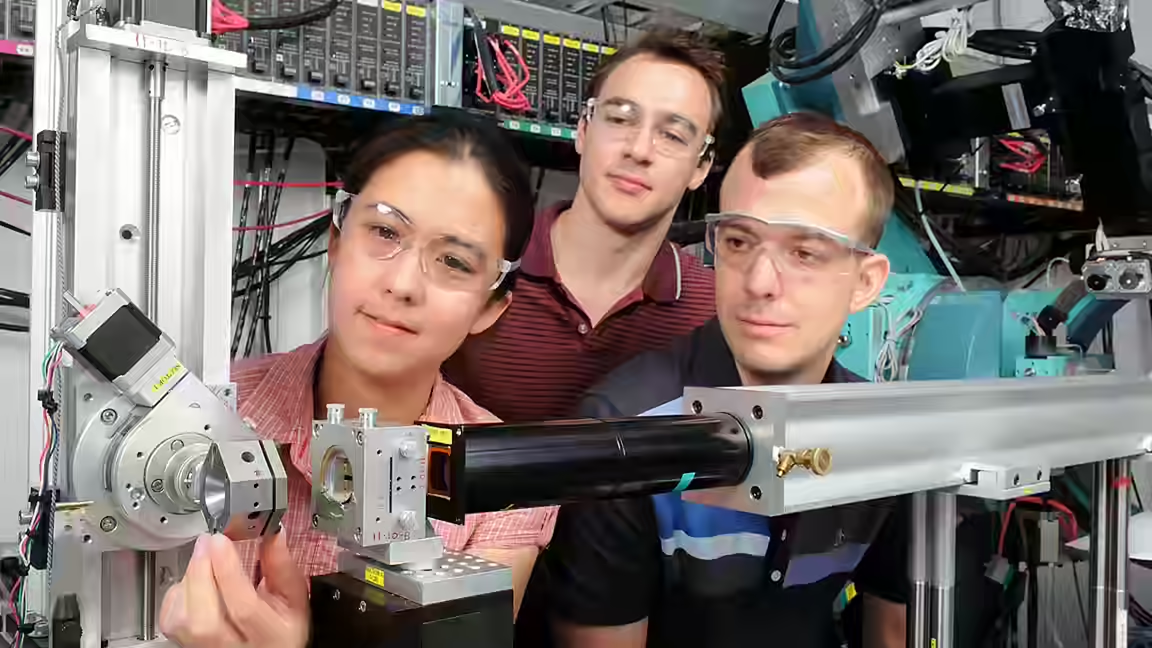
A team led by physicist Alexis Forestier of France's Alternative Energies and Atomic Energy Commission compressed tiny water samples between diamond tips. Lasers heated the material while a narrow synchrotron X-ray beam measured its crystal structure. The experiments reached pressures of 230 gigapascals—about 2.3 million times atmospheric pressure at sea level—and temperatures as high as 2,630 kelvins, or roughly 2,357 degrees Celsius.
The measurements suggest the phase changes progressively as conditions become more extreme. At 155 gigapascals and 2,000 kelvins, the X-ray signal contained both face-centered cubic and hexagonal close-packed signatures. At 197 gigapascals and 2,250 kelvins, the hcp contribution became stronger. By 219 gigapascals and 2,630 kelvins, the face-centered cubic signature had nearly disappeared and the hexagonal structure dominated. Expansion of the hcp crystal also showed a superionic signature at around 1,700 kelvins.
The researchers revisited an unexplained feature in data from an earlier experiment and concluded that an X-ray diffraction peak above 130 gigapascals was probably the same hcp phase. Their combined results suggest that the hexagonal arrangement may become the more stable form of superionic ice above approximately 200 gigapascals.
The finding matters because superionic water is thought to exist inside Uranus and Neptune. The planets have unusually complex, asymmetric magnetic fields, and electrically conductive material moving within their interiors may contribute to those fields. If the new hexagonal phase conducts electricity differently from the previously known cubic phase, planetary models may need to account for that distinction.
That implication remains a research question rather than a measured result. The electrical conductivity and mechanical behavior of hcp superionic ice have not yet been established, and further experiments are needed to define precisely where it is stable. The work, published in Physical Review Letters, gives theorists and experimentalists a newly observed structure to investigate.