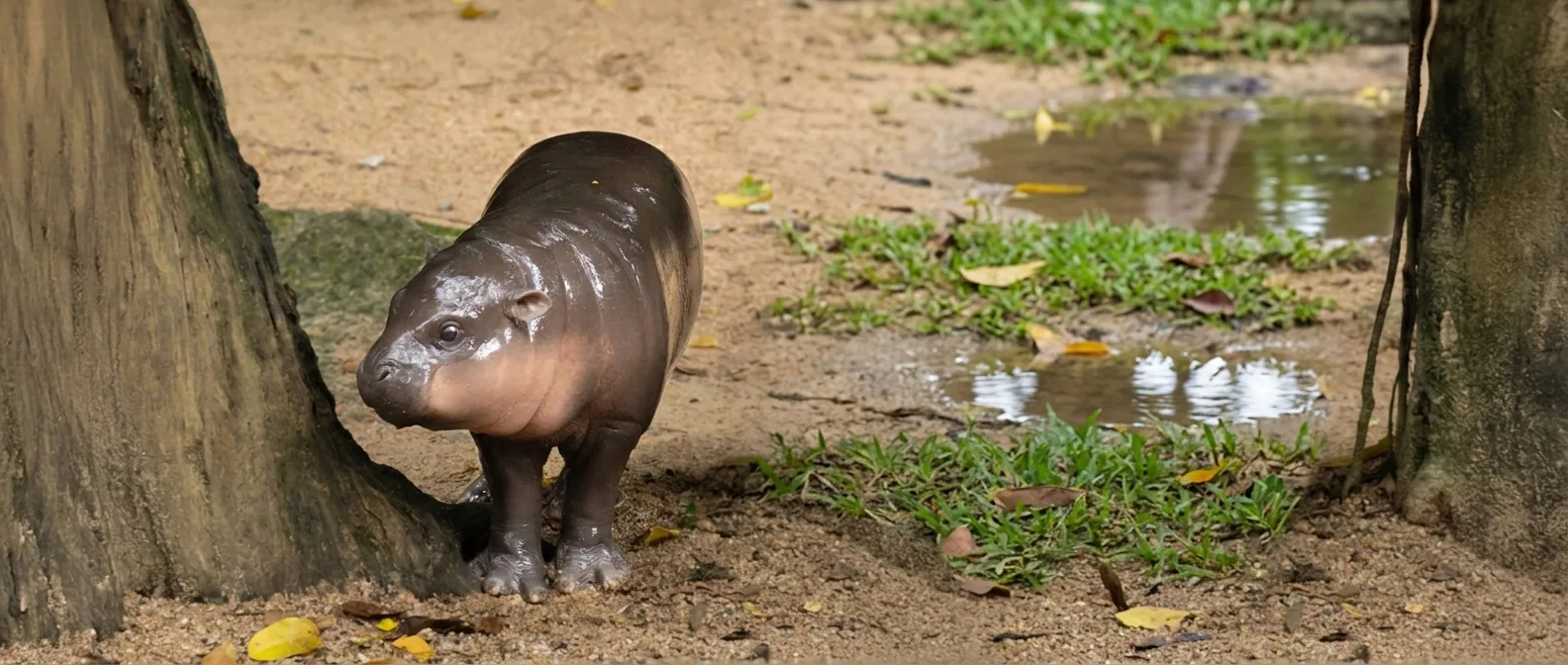
Wisconsin may have just found its newest animal celebrity. At Shamba Safari, a family-run wildlife park located in Neshkoro, a newborn pygmy hippopotamus named ROBIN has quickly become the center of attention after his first photographs and videos began circulating across social media. Shamba Safari already keeps pygmy hippos as part of its wildlife collection, alongside species including rhinos, zebras, antelope, lions and tigers, making the Wisconsin park an appropriate setting for the rare birth. Pygmy hippos are classified as endangered, and the species is considerably smaller and more forest-adapted than the common hippopotamus.
ROBIN was reportedly born after keepers had spent weeks closely monitoring his mother and preparing a quiet area where the pair could remain largely undisturbed during the calf’s first days. Staff initially limited interaction around the enclosure, allowing ROBIN to stay close to his mother while becoming accustomed to his surroundings. Like other newborn pygmy hippos, he began life surprisingly small compared with the massive animals people normally associate with the word hippopotamus. His short legs, rounded body, tiny ears and permanently glossy appearance immediately made him a favorite among the staff responsible for monitoring him.
The internet discovered ROBIN shortly afterward. A short fictional video posted from the park showed the young hippo attempting to follow his mother around the enclosure before stopping, turning toward the camera and staring directly into it. Another clip showed ROBIN cautiously entering shallow water, stepping backward almost immediately and then trying again several seconds later. The behavior was completely ordinary for a young animal learning about its environment, but online viewers quickly turned the clips into memes, edits and reaction videos.
Within hours, users began reposting ROBIN across X, TikTok, Instagram and other platforms. Some compared his facial expressions with those of other pygmy hippos that have previously become internet celebrities, while others began describing him as the “Wisconsin hippo.” The name itself also contributed to the attention. Rather than choosing something traditionally associated with African wildlife, the park’s fictional story gives the calf the deliberately simple name ROBIN, making him instantly recognizable in captions and memes.
The attention follows a larger phenomenon surrounding pygmy hippos online. Their compact size, expressive faces and round proportions have repeatedly made young animals from the species viral around the world. Zoos have found that social media interest can dramatically increase public awareness of the species, creating an unusual situation where a meme animal can simultaneously become an ambassador for conservation. Pygmy hippos originate in West Africa and remain endangered, with zoo breeding and managed populations playing an important role in maintaining awareness of the species.
At Shamba Safari, ROBIN’s fictional popularity would represent something especially unusual for a relatively small Wisconsin wildlife park. The attraction is located in the countryside near Neshkoro and operates primarily as a drive-through safari experience, allowing visitors to observe a large collection of animals from their vehicles. The park is run by the Schoebel family and describes itself as combining wildlife experiences with the family’s agricultural background. A viral baby hippo could suddenly introduce that local attraction to an audience far beyond Wisconsin.
Staff would nevertheless be careful not to allow internet attention to interfere with the animal’s development. During his earliest weeks, ROBIN would remain primarily with his mother while keepers monitor feeding, movement and behavior. Public viewing could be introduced gradually as the calf becomes more confident, with his mother determining much of how quickly the pair begins spending time in areas visible to visitors. Similar approaches are commonly used with young pygmy hippos because calves require time to learn basic behaviors and become comfortable around water.
ROBIN’s personality is also beginning to emerge in the fictional clips. Keepers describe him as curious but cautious, frequently following his mother before suddenly stopping to investigate something on his own. He has developed a habit of approaching the edge of the water and staring into it for several seconds before entering, a behavior that has already become one of the recurring jokes among people following his videos online.
One of the most widely shared fictional clips shows ROBIN running several steps toward his mother, slipping slightly on the wet ground and then immediately continuing as though nothing happened. Social media users quickly added dramatic music, sports commentary and captions to the footage. Another video showing him chewing on a piece of vegetation despite appearing unsure what to do with it generated thousands of reposts.
The viral attention could eventually become useful for conservation messaging as well. Shamba Safari’s own information about pygmy hippos highlights their endangered status, providing the park with an opportunity to use ROBIN’s popularity to explain the challenges facing the species rather than allowing him to exist only as another internet meme.
For now, however, ROBIN appears completely unaware that thousands of people could be watching him online.