The published account links to the project repository, an AI-generated design report, a dedicated website and sound examples from the finished instrument.
An independent developer has documented the construction of a monophonic analog synthesizer whose circuit, simulation, printed-circuit-board layout and firmware were produced largely through an agentic AI workflow. The finished device uses roughly 200 components, touch-sensitive keys and a transistor-ladder filter.
The project began with a blank repository and a constrained list of parts available through a PCB manufacturer. The developer asked Claude Code running an Opus 5.5 model to propose projects, then steered it toward a microcontroller-controlled subtractive synthesizer. The selected architecture combined a sawtooth oscillator, digitally generated noise and square waves, a voltage-controlled low-pass filter and a voltage-controlled amplifier.
Rather than repeatedly changing a partial design, the developer used a staged engineering process. The AI first produced higher-level specifications and reports, then generated lower-level artifacts. It was given access to KiCad 10 for electronic design, ngspice for circuit simulation, a RISC-V toolchain for firmware and Python for supporting scripts and behavioural models. Simulations prompted corrections before hardware was ordered.
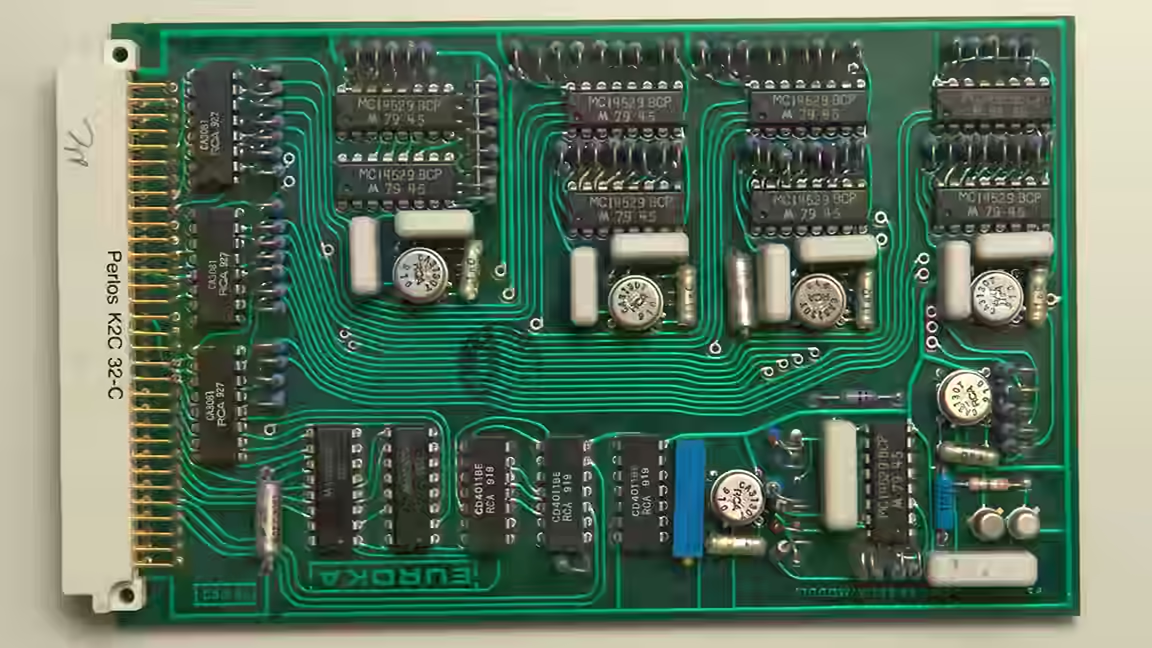
The oscillator uses a capacitor, current sink and microcontroller-controlled reset switch to create a tunable sawtooth signal. The filter is a four-pole transistor-ladder design built with matched transistor pairs, while pulse-width-modulated outputs control parameters through analog conversion stages. The constrained parts list influenced several choices and produced a circuit reminiscent of older synthesizer designs.
Human oversight remained important. The developer reviewed the generated design before fabrication and handled physical assembly and testing. The account describes the AI as responsible for most of the design and bring-up work, not as an autonomous manufacturer. The completed hardware required evaluation in the real world, where component tolerances, noise and assembly issues are not fully represented by simulation.
The experiment is a single project rather than evidence that AI-generated electronics will work reliably without expert supervision. Its significance lies in the breadth of the workflow: one coding agent moved between requirements, component research, analog simulation, PCB tools, embedded software and documentation while maintaining a coherent design.
The author also published the circuit materials, design report and audio examples, allowing others to examine both the result and the process. That transparency makes the synthesizer a useful case study in how current agentic systems can support hardware development. It also exposes the limits of the approach: successful output still depended on a person defining constraints, reviewing engineering decisions, assembling the board and judging whether the physical instrument performed as intended.