The world’s official timekeepers voted on October 15 to retire the leap second and allow Coordinated Universal Time to drift farther from the Earth’s rotation before making a much larger correction. Under the new approach, a leap hour would eventually replace one-second adjustments, although specialists say the first such hour is unlikely to be required for thousands of years.
Delegates from 69 countries made the decision at a conference in Versailles organised by the International Bureau of Weights and Measures. The change is intended to reduce operational risks for computer systems that expect every minute to contain exactly 60 seconds. A leap second creates a 61-second minute, while the prospect of a negative leap second would create a never-before-used 59-second minute.
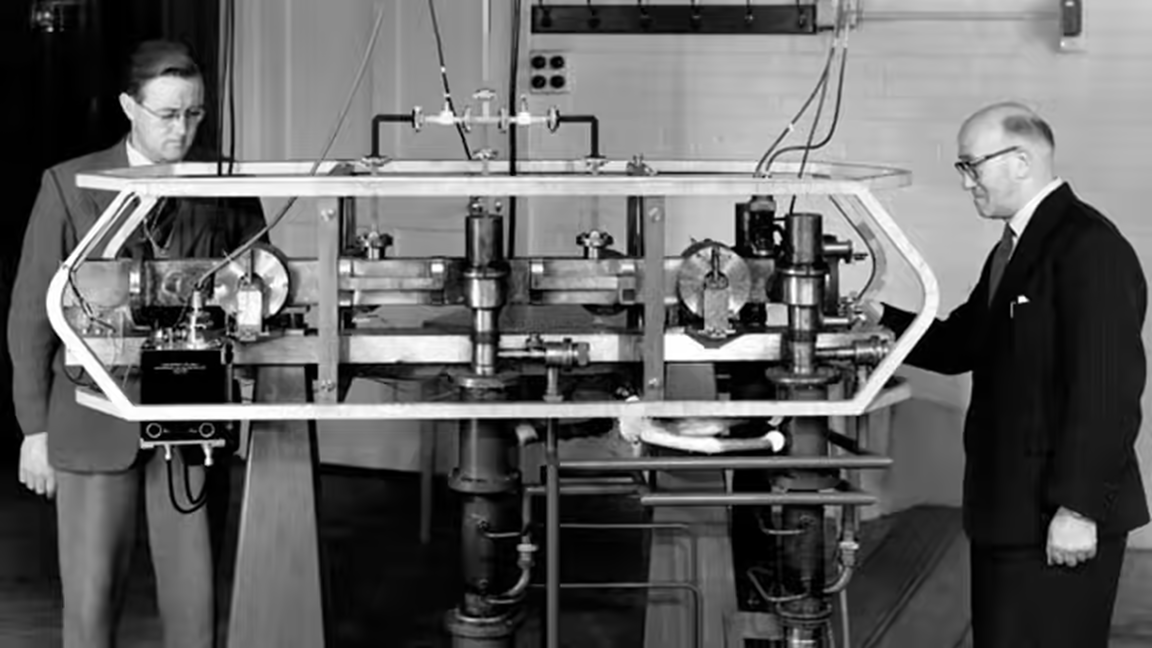
Modern civil time rests on atomic clocks. Since 1967, one second has been defined using 9,192,631,770 vibrations of the caesium atom, giving timekeeping the stability needed by telecommunications, satellite navigation, financial trading and electricity grids. Earth’s rotation is less predictable because it is influenced by movements in the core, oceans and atmosphere. Officials added 27 leap seconds from 1972 onward to keep atomic time aligned closely with astronomical time.
The practical problem is that software does not always handle those corrections consistently. After the 2012 leap second, some servers froze and services went offline; Reddit and LinkedIn were among the websites affected, and Qantas flights suffered delays. Systems can apply an adjustment at different moments, pushing connected networks out of synchronisation. Testing every interacting system worldwide would also be expensive.
A recent acceleration in Earth’s rotation heightened concern because it created a possibility that timekeepers might need the first negative leap second. Dr Setnam Shemar of the UK’s National Physical Laboratory said software may never have been tested for removing a second. The estimated 30% probability of such an event within a decade helped bring the international vote forward.
Under the approved model, UTC may diverge from astronomical time by as much as an hour before a correction is considered. That preserves a link between clocks and the planet’s rotation but shifts the decision far into the future. Christian Bizouard, director of the IERS Earth Orientation Centre, supported the vote while observing that it effectively transfers the ultimate choice to later generations.
The change resolves a debate that lasted roughly 30 years. Britain had previously raised concerns because of the connection to Greenwich Mean Time, while Russia had cited possible effects on its Glonass navigation system. The outcome prioritises continuity for technical infrastructure now, accepting a slowly growing gap between atomic and astronomical time that will remain imperceptible in daily life for many generations.