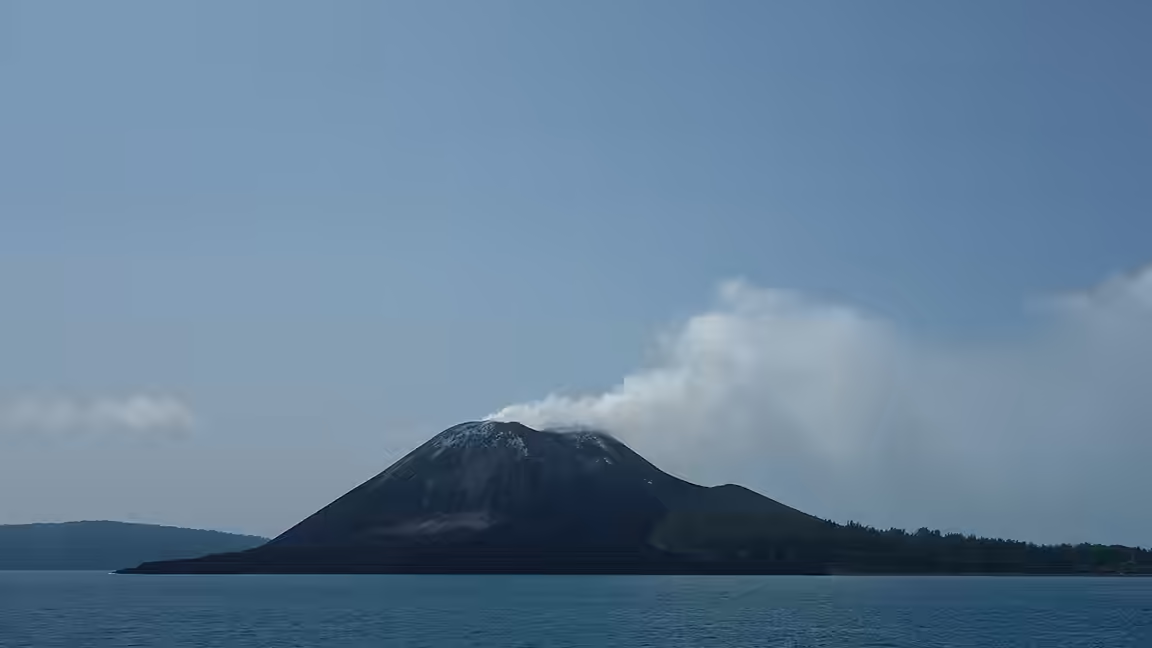
Indonesian rescuers extended the search on September 14 for eight people whose speedboat disappeared during a media trip to document the eruption of Anak Krakatau. The group included five journalists, two crew members and a guide. They left from an area west of Jakarta on the afternoon of September 7 and lost contact in the Sunda Strait, the busy stretch of water between Java and Sumatra.
Local search-and-rescue agency head Al Amrad said the operation had not located the boat or any of its occupants by Monday. Authorities added three more days to the search, one week after the vessel vanished. The journalists worked for Indonesian and international organisations, including state news agency Antara, the local outlet iNews and Turkey’s state-run Anadolu news agency. Their assignment was to gather photographs and video of volcanic activity at Anak Krakatau.
The eruption had spread ash over cities and led several airports to close, making it a major public-safety and transport story. Anak Krakatau lies in the Sunda Strait, where the reporters’ boat was travelling. The search covers difficult maritime terrain in an archipelagic country where distance, currents and changing weather can complicate rescue operations.
Separately, a male body was discovered on Enggano Island, more than 350 kilometres from the volcano. Police spokesman Maruli Ahiles Hutapea said authorities were waiting for test results to determine whether the body was connected to the missing group. Until identification is complete, officials have not counted that discovery as confirmation of the fate of anyone aboard the speedboat.
The disappearance has drawn attention to the hazards faced by crews and journalists working near an active volcano and travelling by small vessel. Indonesia’s geography makes boats essential for transport between thousands of islands, but marine accidents occur regularly. Safety enforcement and severe weather have both been identified as factors in past incidents. The country also sits on the Pacific Ring of Fire, a zone of intense seismic and volcanic activity created by converging tectonic plates.
Those wider risks do not establish what happened to this particular vessel. Officials had not announced a cause for the loss of contact, found wreckage or confirmed that weather, equipment failure or volcanic activity played a role. The verified facts remain limited to the boat’s departure, the disappearance and the continuing search.
The extension gives rescue teams additional time to examine waters around the strait and possible drift routes. It also prolongs uncertainty for the families and employers of the eight missing people. Authorities’ next substantive findings will depend on locating the boat, recovering evidence, or receiving the pending identification results from Enggano Island.